
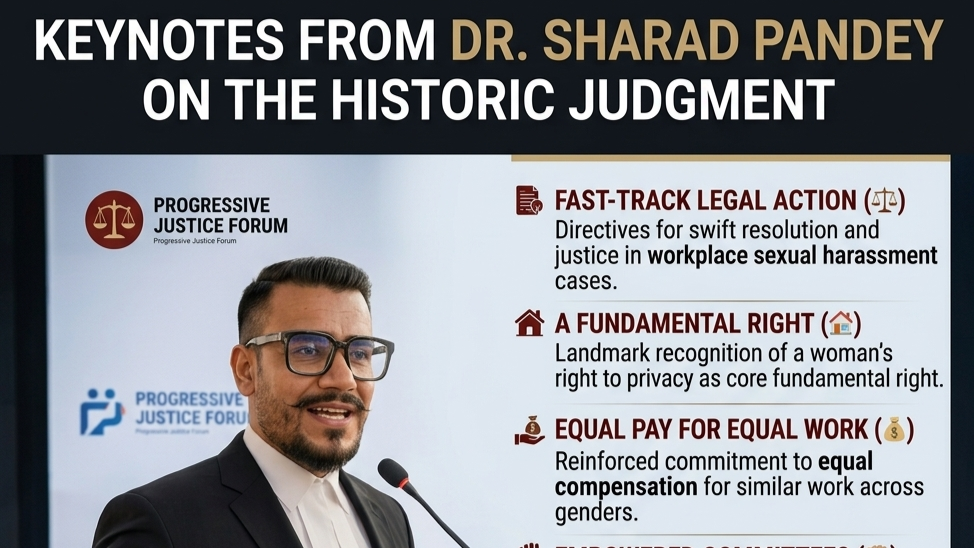
The legal landscape of India has witnessed a monumental shift. In a groundbreaking judgment, the Supreme Court of India has firmly asserted that a woman’s dignity and safety are paramount. This historic decision is not just a win for women; it is a definitive stride toward building an equitable, progressive society.
As a legal professional observing the evolution of our constitutional rights, I view this verdict as a critical cornerstone. It addresses deep-seated workplace challenges by reinforcing safety, solidifying privacy, and demanding absolute equality.
The Core Pillars of the Supreme Court Judgment
The Supreme Court’s ruling lays down stringent guidelines to ensure that women feel safe, protected, and respected across all professional environments. The major highlights of this historic verdict include:
1. Fast-Track Action Against Workplace Sexual Harassment
The Court issued mandatory directives for swift and effective action in cases of sexual harassment at the workplace. Employers are now under strict legal obligation to make Internal Complaints Committees (ICC) completely transparent, responsive, and free from organizational bias.
2. Right to Privacy Elevated to a Fundamental Right for Women
In an extraordinary move, the right to privacy for women has been explicitly recognized as an unalienable Fundamental Right. This ensures that during any sensitive legal proceedings or workplace disputes, the identity and personal history of the victim remain strictly confidential.
3. Non-Negotiable Protection from Retaliation
A common deterrent for women reporting harassment is the fear of professional backlash or social isolation. The Supreme Court has mandated absolute protection from retaliation for survivors, ensuring that speaking up does not cost a woman her career, safety, or peace of mind.
4. Direct Impulsion for Equal Pay for Equal Work
Gender pay gaps have lingered in various industries for far too long. The apex court has put immense emphasis on eliminating wage disparity, reinforcing that equal work must translate to equal pay, irrespective of gender.
Insights from the Judiciary
The ruling has drawn profound statements from the highest ranks of India’s judiciary, reinforcing the constitutional gravity of this decision.
“Women’s dignity and safety are our constitutional commitment. This judgment is a vital step toward equality and justice.” — Hon’ble Chief Justice, Justice Sanjiv Khanna
This statement underscores that women’s rights are not an afterthought; they are deeply woven into the fabric of the Indian Constitution. Furthermore, the broader narrative of the judgment emphasizes a vital societal truth:
Until women feel safe, secure, and genuinely respected in every sphere of life, the dream of a fully developed, prosperous India (‘Viksit Bharat’) will remain incomplete.
Dr. Sharad Pandey’s Perspective: Why This Verdict Matters
This historic judgment is much more than a collection of legal directives; it is a social catalyst. For decades, statutory bodies and internal mechanisms like the ICC existed on paper, but their implementation often lacked teeth. By making internal bodies strictly accountable and punishing retaliatory behavior, the Supreme Court has cleared the path for women to reclaim their professional spaces without fear.
True progress is measured by how safely and confidently a nation’s workforce can operate. By treating Privacy, Safety, and Pay Parity not as privileges, but as fundamental rights, the Supreme Court has sent a clear message to employers across the country: Accountability is no longer optional.
The Road Ahead: Transforming Mindsets
Laws can penalize the wrongdoer, but true equality blooms when societal mindsets transform. This judgment lays down a solid framework that forces corporate and public institutions to look at women workers through the lens of equality and respect.
As we move forward, the responsibility falls on employers, HR professionals, and legal practitioners to implement these directives to the letter. It is time to transform our workplaces into safe havens of merit, dignity, and equal opportunity.
About the Author: Dr. Sharad Pandey is an advocate based in Raipur, dedicated to decoding constitutional law, labor rights, and landmark judicial updates.