
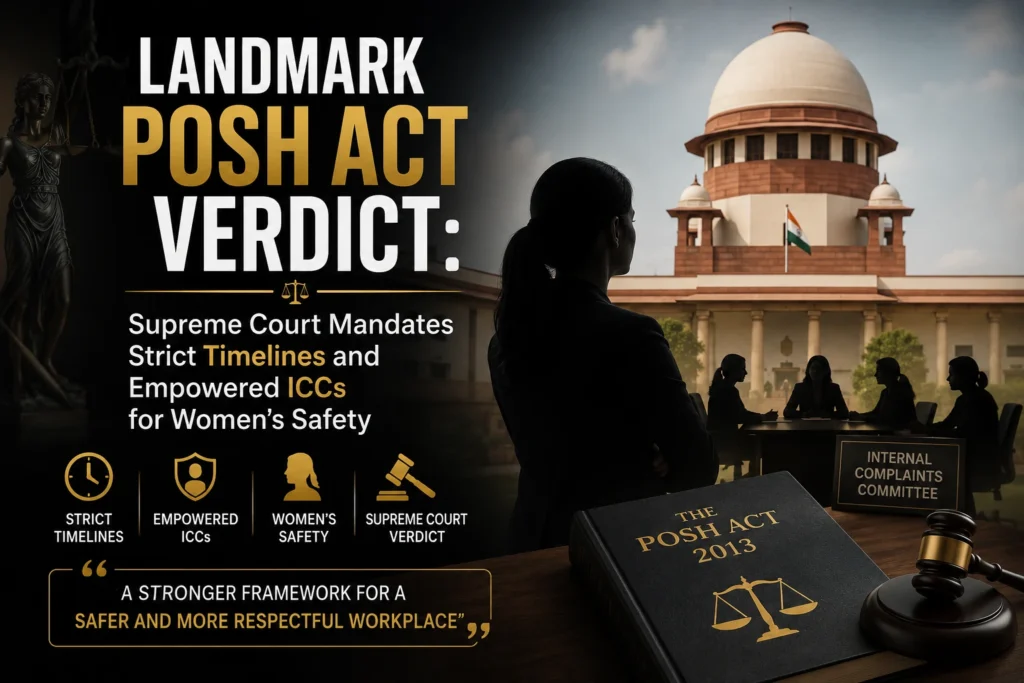
The Supreme Court of India has taken a decisive, monumental step toward securing the safety and dignity of women in the workplace. By issuing strict, comprehensive directives to overhaul the implementation of the Prevention of Sexual Harassment (POSH) Act, 2013, the apex court has sent a crystal-clear message to employers across the nation: ensuring a safe working environment is an absolute legal mandate, not a choice.
As a legal professional tracking structural reforms in labor laws, I view this judgment as a crucial turning point. It addresses the systemic delays that historically plagued workplace grievance redressal and establishes strict institutional accountability.
Directives from the Apex Court: Strengthening the POSH Framework
The newspaper feature in Dainik Jansatta highlights the key legal enforcement mechanisms introduced by this historic judgment to tackle workplace harassment effectively.
1. Mandatory Strengthening of Internal Complaints Committees (ICC)
The Supreme Court has made it compulsory for every organization—both public and private—to make their Internal Complaints Committees (ICC) highly effective, robust, and completely transparent. Committees can no longer exist as mere paperwork; they must be actively trained and legally equipped to handle grievances without corporate interference.
2. The 90-Day Binding Resolution Window
One of the most significant aspects of this ruling is the implementation of strict time limits. The Court has mandated that all workplace harassment complaints must be completely investigated and resolved within a maximum period of 90 days. This prevents organizations from dragging out cases to exhaust or pressure the complainant.
3. Absolute Confidentiality and Protection of Identity
To encourage survivors to report misconduct without fear of societal stigma or professional blacklisting, the judgment places a heavy emphasis on complete privacy. The identity of the victim and the details of the ongoing inquiry must remain strictly confidential throughout and after the legal proceedings.
4. Severe Punishments for Guilty Parties
The ruling explicitly directs organizations to implement stringent, uncompromised disciplinary actions against anyone found guilty of sexual harassment, reinforcing that misconduct will meet with swift legal and professional consequences.
Quotes from the Judiciary & Legal Insights
The core of the judgment rests on a profound constitutional principle regarding employer accountability:
“Providing a safe workplace for women is the responsibility of every single employer. Any negligence or laxity in this matter is completely unacceptable.” — Supreme Court of India
This shifting of the burden directly onto the leadership of an organization means that passive ignorance is no longer a valid legal defense for executives or business owners.
Dr. Sharad Pandey’s Perspective: Accountability and Awareness are the Keys to Change
From my legal practice, I have frequently observed that while the POSH Act of 2013 was a beautiful piece of legislation on paper, its ground-level execution often lacked the necessary teeth. Delays in committee formations and fear of professional retaliation frequently silenced victims.
By mandating a 90-day resolution timeline and ensuring complete protection of the survivor’s identity, the Supreme Court has removed the massive barriers that prevented women from seeking justice.
However, a law is only as strong as its execution. This judgment will successfully empower women’s rights and make workplaces safer only if two elements run parallel: continuous awareness and timely action.
Moving Forward: What Employers Need to Do Instantly
To align with this landmark Supreme Court ruling, organizations must immediately take the following compliance steps:
- Audit current ICC structures to ensure they meet statutory gender and external member composition requirements.
- Conduct mandatory POSH compliance training for all management-level executives and employees.
- Establish strict data protocols to guarantee the absolute confidentiality of any grievance filed within the system.
Achieving a truly progressive society and fulfilling the vision of a developed nation requires creating spaces where merit triumphs over vulnerability, and where every woman can work with uncompromised dignity.
About the Author: Advocate Dr. Sharad Pandey is a legal practitioner specializing in constitutional law and labor compliance, focused on bridging the gap between statutory rights and ground-level execution.