
Introduction
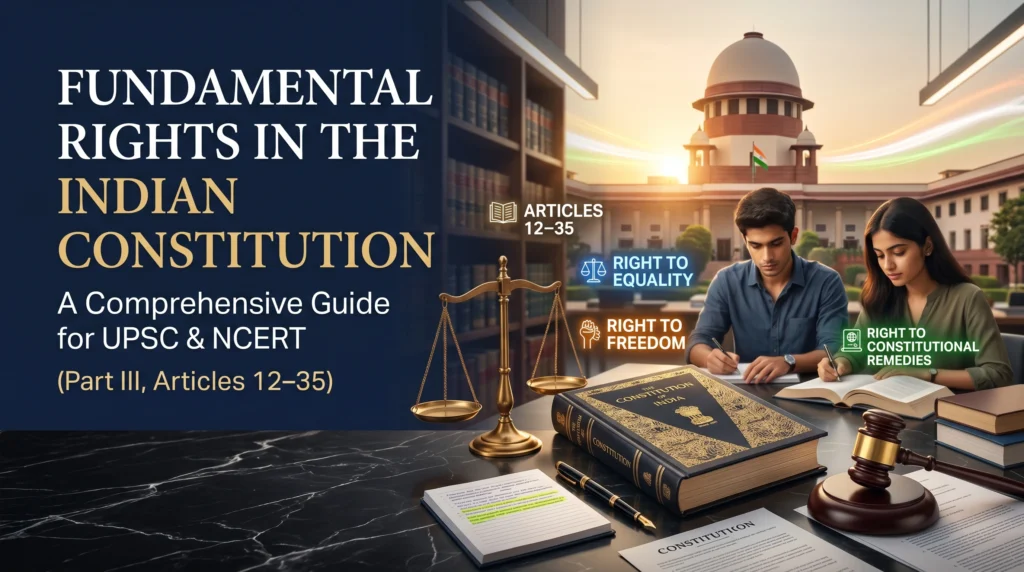
Fundamental Rights are the cornerstone of the Indian Constitution and form the foundation of democracy, liberty, equality, and justice in India. Enshrined in Part III of the Constitution (Articles 12–35), these rights protect citizens against arbitrary state action and ensure the dignity and freedom of every individual.
Dr. B.R. Ambedkar described Fundamental Rights as the “heart and soul” of the Constitution because they guarantee essential freedoms and provide legal remedies against violations.
This guide is particularly useful for UPSC aspirants, law students, NCERT learners, and anyone interested in understanding constitutional governance in India.
What Are Fundamental Rights?
Fundamental Rights are basic human freedoms guaranteed by the Constitution of India. These rights enable citizens to live with dignity and promote equality, justice, and democratic values.
They are enforceable by courts, and any law violating these rights can be challenged before the judiciary.
Fundamental Rights Under Part III
The Constitution originally provided seven Fundamental Rights. Currently, six Fundamental Rights remain after the Right to Property was removed as a Fundamental Right by the 44th Constitutional Amendment.
1. Right to Equality (Articles 14–18)
The Right to Equality ensures equal treatment before the law and prohibits discrimination.
Key Provisions:
Article 14
Equality before law and equal protection of laws.
Article 15
Prohibits discrimination on grounds of:
- Religion
- Race
- Caste
- Sex
- Place of birth
Article 16
Equality of opportunity in public employment.
Articles 17 & 18
- Abolition of untouchability
- Abolition of titles
2. Right to Freedom (Articles 19–22)
This right guarantees personal liberty and democratic participation.
Article 19
Citizens enjoy six essential freedoms:
- Freedom of speech and expression
- Freedom of assembly
- Freedom of association
- Freedom of movement
- Freedom of residence
- Freedom of profession and occupation
Article 20
Protection in criminal cases against:
- Ex-post facto laws
- Double jeopardy
- Self-incrimination
Article 21
Protection of life and personal liberty.
The Supreme Court has expanded Article 21 to include:
- Right to privacy
- Right to dignity
- Right to clean environment
- Right to education
- Right to legal aid
Article 22
Protection against arbitrary arrest and detention.
3. Right Against Exploitation (Articles 23–24)
These provisions safeguard human dignity.
Article 23
Prohibits:
- Human trafficking
- Forced labour
- Begar
Article 24
Prohibits employment of children below 14 years in hazardous industries.
4. Right to Freedom of Religion (Articles 25–28)
India is a secular nation where every individual enjoys religious freedom.
Article 25
Freedom of conscience and religion.
Article 26
Freedom to manage religious affairs.
Article 27
Freedom from paying taxes for promotion of a particular religion.
Article 28
Freedom regarding religious instruction in educational institutions.
5. Cultural and Educational Rights (Articles 29–30)
These rights protect India’s cultural diversity and minority communities.
Article 29
Protects the language, script, and culture of minorities.
Article 30
Grants minorities the right to establish and administer educational institutions. The State cannot discriminate against minority educational institutions while granting aid.
6. Right to Constitutional Remedies (Article 32)
Article 32 is often called the “Heart and Soul of the Constitution.”
It empowers citizens to directly approach the Supreme Court for enforcement of Fundamental Rights.
Constitutional Writs
The Supreme Court and High Courts can issue five writs:
Habeas Corpus
Protects individuals from unlawful detention.
Mandamus
Directs public authorities to perform their duties.
Prohibition
Prevents lower courts from exceeding jurisdiction.
Certiorari
Transfers or quashes orders of lower courts.
Quo Warranto
Challenges unlawful occupation of a public office.
Articles 33–35: Special Provisions
Article 33
Parliament can restrict Fundamental Rights of:
- Armed Forces
- Police Forces
- Intelligence Agencies
to ensure discipline and proper discharge of duties.
Article 34
Fundamental Rights may be restricted during Martial Law in specific areas.
Article 35
Only Parliament has the authority to make laws for implementing certain Fundamental Rights.
Important Features of Fundamental Rights
Fundamental Rights possess several unique characteristics:
Judicial Protection
The Supreme Court acts as the guardian of Fundamental Rights.
Enforceability
Citizens can approach High Courts or the Supreme Court if these rights are violated.
Constitutional Status
These rights can only be amended through a constitutional amendment.
Emergency Provisions
During a National Emergency, most Fundamental Rights may be suspended except Articles 20 and 21.
Landmark Doctrines Related to Fundamental Rights
Doctrine of Severability
If a part of a law violates Fundamental Rights, only the unconstitutional portion is declared void while the rest of the law remains valid.
Doctrine of Eclipse
A law inconsistent with Fundamental Rights does not become completely invalid; it remains dormant until the inconsistency is removed.
Amendments and Fundamental Rights
The Supreme Court in the landmark Kesavananda Bharati Case held that Parliament can amend the Constitution, including Fundamental Rights, but cannot alter the Basic Structure of the Constitution.
This judgment remains one of the most significant decisions in Indian constitutional law.
Criticism of Fundamental Rights
Despite their importance, some criticisms exist:
- Rights are subject to reasonable restrictions.
- Several socio-economic rights are not included as Fundamental Rights.
- National emergencies can affect their operation.
- Certain constitutional terms remain broadly interpreted.
Why Fundamental Rights Matter
Fundamental Rights are essential because they:
✅ Protect individual liberty
✅ Promote equality and justice
✅ Prevent arbitrary state action
✅ Safeguard democracy
✅ Protect minority interests
✅ Ensure constitutional governance
The framers of the Constitution included these rights to prevent authoritarian rule and strengthen democratic values in India.
Conclusion
Fundamental Rights are the backbone of India’s constitutional framework. They empower citizens, preserve democratic values, and maintain a balance between individual liberty and state authority. For UPSC aspirants, law students, and informed citizens, understanding Articles 12–35 is crucial for grasping the essence of Indian democracy and constitutional governance.
Written by:
Dr. Sharad Pandey
Advocate & Legal Consultant | Raipur, Chhattisgarh
📞 9098222001